





News
 
  • Responding to Dr. Vera Yuen: Building a More Inclusive and Safe Road Transport System is the Long-Term Solution
  •  
  • Submission of views for the public consultation on Hong Kong’s Five-Year Plan
  •  
  • Prompting Pedestrians to Use Push Buttons at Crossings
  •  
  • Flyover from Kwai Tsing Interchange Upramp to Kwai Chung Road - Comments and Recommendations
  •  
  • Sixth United Nations Global Road Safety Week 2021
  •  
  • Fourth United Nations Global Road Safety Week 2017
  •  
  • Concerns for Roadworks and Public Transport Safety
  •  
  • Seminar: Measuring Risk on the World''s Roads and making Targeted Improvements (iRAP)
  •  
  • CRS presented at Panel on Transport regarding PTSS - Taxis service
  • More...
     
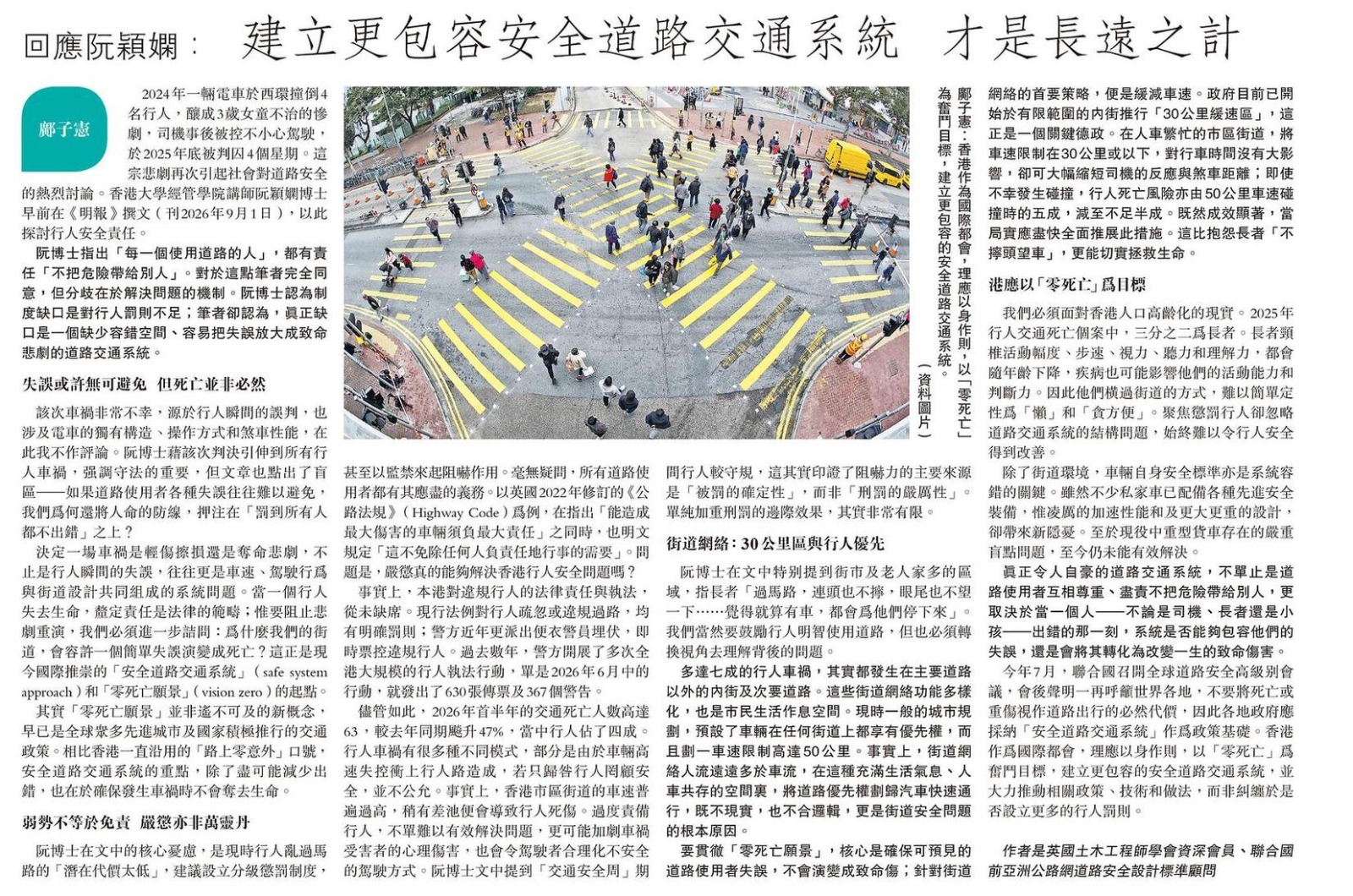
    Responding to Dr. Vera Yuen: Building a More Inclusive and Safe Road Transport System is the Long-Term Solution [09] 
     

    In a recent op-ed published in Ming Pao, Julian delves into the ongoing public debate surrounding pedestrian safety and traffic enforcement in Hong Kong.

    Recently, Dr. Yuen pointed out that every road user has a responsibility not to bring danger to others. Julian fully agrees with this principle. However, their views diverge on the mechanism for solving the problem. While Dr. Yuen suggests that the systemic gap lies in insufficient penalties for pedestrians, Julian argues that the real flaw is a road transport system that lacks room for error, easily magnifying momentary mistakes into fatal tragedies. In his article, Julian explains why Hong Kong must shift its focus toward building a forgiving road network.

    Key Highlights from the Article:

    • Human Errors are Inevitable; Fatalities are Not

      Legal enforcement and fines have inherent limits. A modern road system must be designed to be "forgiving"—ensuring that a momentary lapse in judgment by a driver or pedestrian does not turn into a fatal tragedy. This is the very foundation of the globally recognized "Safe System" approach.

    • Vulnerability Does Not Mean Exemption; Severe Punishments Are Not a Panacea

      While all road users share responsibilities, simply increasing fines and penalties for pedestrians is not the ultimate solution. Over-relying on punitive measures fails to address the underlying structural issues and traffic engineering flaws that put lives at risk in the first place.

    • Street Networks: 30 km/h Zones & Pedestrian Priority

      Streets are vital living spaces, yet a standard 50 km/h limit often persists in dense areas. Implementing 30 km/h speed-limit zones in inner-city neighborhoods drastically lowers collision impact energy. Following international best practices, this reduces fatal injury risks significantly while having a minimal impact on overall travel times.

    • Hong Kong Should Aim for "Vision Zero"

      With an aging population—where the elderly account for two-thirds of pedestrian fatalities—declining mobility, vision, and reaction times are realities we must proactively design for. Achieving "Vision Zero" requires addressing the needs of all road users through comprehensive solutions, including fixing vehicle blind spots and prioritizing safe, aesthetic streetscape integration over placing blame.